 AstroKinetics · ASTRA
Team AI-MED 01 · Houston, Texas · 2026 NASA International Space Apps Challenge
Offline-first astronaut health monitoring when Houston is 44 minutes away
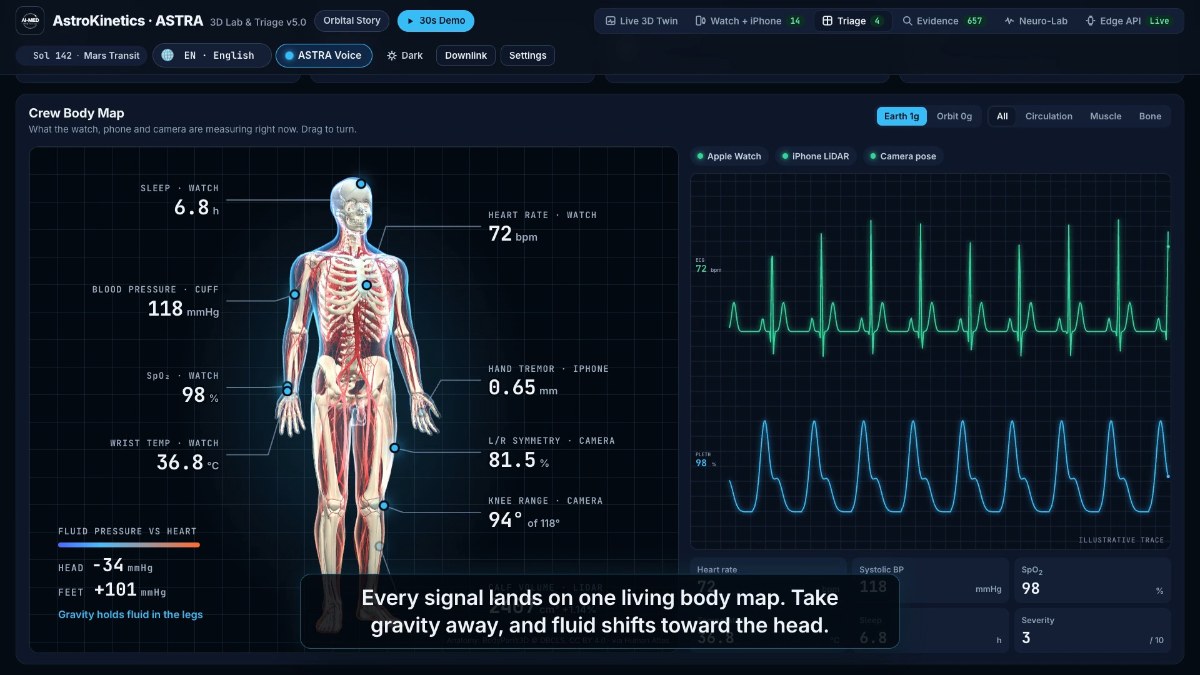
AstroKinetics · ASTRA is an open-source (MIT) web research prototype built in Houston for the NASA Space Apps challenge Create Health Monitoring Software for Astronauts on Space Missions. It gathers movement, wearable, and habitat signals locally, checks eight emergency red flags first, separates coupled environmental and physiological drift offline, and links every output to cited NASA sources.
Why can’t deep-space crews rely on real-time Houston Mission Control?
One-way Mars communications delays reach up to 22 minutes (44 minutes round-trip), and solar conjunctions cut Earth contact altogether. When overlapping symptoms such as slower reaction time, tremor, or fatigue appear during a blackout, astronauts need autonomous onboard software that separates cabin environmental drift from physiological deconditioning and queues compact (<2 KB) store-and-forward packets for flight surgeons.
Space-to-Earth dual-use impact: The exact same zero-cloud camera kinematics, contactless rPPG, smartwatch telemetry bus, and offline triage workflow runs on commodity hardware for rural Texas clinics, austere disaster response, and home neuro-musculoskeletal tele-rehabilitation without broadband or cloud PHI exposure.
NASA NTRS 20220013418 · Mars communications delay analysisHow does AstroKinetics · ASTRA go beyond a basic vitals dashboard?
It unifies six deterministic, inspectable mechanisms in one offline-capable workstation:
- Gather locally (zero cloud video): Browser WebAssembly/WebGPU MediaPipe (478-pt FaceMesh Wang POS rPPG, 33-pt 3D WorldPose with 1-Euro filtering, 21-pt Hands tremor) plus a crew-isolated REST telemetry sandbox.
- Earth-to-Orbit baseline adaptation: A 14-day personal baseline (224 readings across 16 measures) shifts expected ranges when entering microgravity, grounded in NASA’s Barger et al. (2014) ISS sleep norm (6.09 ± 0.67 h).
- 8-DOF Mahalanobis whitening (Σ−1/2): Decomposes coupled multi-sensor drift into exact variance shares (% of DM2) and χ28 survival p-values with identical Python and offline JavaScript math.
- Red-flag-first safety & abstention: Eight NASA HUNCH emergency rules run in <1 ms before quality gates; poor capture abstains (
INCOMPLETE_CHECK_REQUIRED) instead of imputing normal defaults. - ASTRA episode governance & LiDAR volumetry: Enforces clinician-gated episode closure and computes exact closed-mesh signed tetrahedral limb volume while rejecting depth-hallucinating capture modes.
- 3-tier crew privacy & 3D Crew Body Map: Redacts personal mood/journal logs for CMO and Flight Surgeon views both online and offline, and renders signals on BodyParts3D 4.0 anatomy (CC BY 4.0).
Post-submission software verification · Updated November 21, 2026
Does AstroKinetics · ASTRA pass reproducible offline, safety, privacy, and math checks?
Yes — 7 of 7 live read-only check groups pass on GET /api/verification-report, and 7 end-to-end local regression suites pass via node scripts/verify_judging_workflow.mjs. In the cabin CO₂ case, a simulated 2.85 mmHg CO₂ snapshot and 322 ms reaction time trigger Watch status (78.3/100) and prompt the crew to verify the cabin trend and repeat the task. All four scripted cases plus 16 boundary/stress vectors match exactly between the Python server (scipy.stats.chi2) and the cached offline browser scorer (static/dsp.js).
| Mission case | Alert level | Demo index | Mahalanobis DM | Server / Offline parity |
|---|---|---|---|---|
| Sol 14 · Nominal lunar orbit | Nominal | 99.2 / 100 | 0.73 | Exact match |
| Sol 88 · Cabin CO₂ drift | Watch | 78.3 / 100 | 3.85 | Exact match |
| Sol 142 · Musculoskeletal asymmetry | Alert | 44.7 / 100 | 6.99 | Exact match |
| Sol 210 · Solar particle event blackout | Alert | 12.0 / 100 | 14.81 | Exact match |
| Verification suite | Result | What was tested | Inspect live |
|---|---|---|---|
| Server / Offline statistical parity | 20 / 20 pass | 4 mission scenarios + 16 domain-boundary vectors match exactly on DM, DM2, χ28 p-value, readiness index, and top attributions between Python and offline JS. | /api/scenarios |
| 3-tier crew privacy redaction | 4 / 4 pass | cmo_operational and flight_surgeon_packet redact mood and private journal logs in non-alert states and escalate only an encrypted flag on alert (both online and offline). |
/api/verification-report |
| NASA HUNCH 8-red-flag safety gate | 10 / 10 pass | All 8 emergency red flags return EMERGENCY even under insufficient capture & disconnected watch; degraded non-red-flag capture abstains (INCOMPLETE_CHECK_REQUIRED) and audits ML disagreement; 5.9 h sleep shifts from MODERATE (Earth-1g) to LOW (Mission-Microgravity). |
/api/hunch/catalog |
| ASTRA episode state-machine governance | 6 / 6 pass | Notification dismissal preserves pending; bad capture sets repeat_required; premature closure fails HTTP 409; offline sync queues and online sync separates remote_received from human_reviewed idempotently; empty closure rationale fails HTTP 422. |
/api/astra/contracts |
| LiDAR signed tetrahedral volumetry | 3 / 3 pass | Closed 10×10×10 cm analytical cube evaluates to exactly 1000.0 mL (0.00% error, PASS); <82% coverage and ARKit personSegmentationWithDepth both trigger QUALITY_HOLD. |
/api/verification-report |
| Crew / Sol telemetry API isolation | 5 / 5 pass | Synthetic watch and phone packets merge only for matching (crew_member, mission_sol), isolate other crew/days, report received_channels vs demo_default_channels, return WKHapticType cues, and reject HR=500 with HTTP 422. |
Telemetry sandbox |
| Bundled NASA data & AURA guardrails | 5 / 5 pass | Verified 14 OSD-571 proteins × 4 crew × 6 timepoints (including raw log10 fold-change check), 164 RadLab ISS DosTel rows, 673 AURA indexed items, and strict exclusion of rodent/cellular papers when human_only=true. |
/api/aura/overview |
Reproduce the offline test in Chrome: Open the cabin CO₂ case once online, wait for the service worker (v5.2.0) to activate, switch DevTools Network to Offline, and reload. Confirm “Offline edge triage”, Watch status, and a 78.3/100 demo index.
Reproduce the full CLI regression suite locally: Run node scripts/verify_judging_workflow.mjs http://127.0.0.1:8080 against a fresh local server from webapp/ using Node.js 24, or inspect the read-only live report at /api/verification-report.
Explicit scope and unverified limits: All verification results above are post-submission software and mathematical checks (dated November 21, 2026) using simulated crew telemetry and fixed prototype references. Clinical diagnostic accuracy, medical efficacy, flight qualification, validation on representative in-flight wearable cohorts, and native watchOS HealthKit / iOS ARKit hardware capture remain unverified. Cached scoring runs offline in the browser after one online load; server SQLite persistence, REST telemetry receipts, and optional xAI Grok Voice cloud TTS/chat require connectivity.
Which official NASA datasets and space-medicine standards power AstroKinetics · ASTRA?
Eight NASA and spaceflight resources are directly bundled or cited across the Evidence, Triage, and Workstation APIs — with explicit separation between human clinical guidance and model-organism research.
- NASA OSDR OSD-571 (GLDS-563) · SpaceX Inspiration4 Plasma Proteomics
- Bundled longitudinal measurements for 14 selected proteins across 4 crew members (C001–C004) and 6 timepoints (L-92, L-44, L-3, R+1, R+45, R+82) from 1,443 screened proteins, plus live REST metadata checks. Supplies spaceflight biological context; the readiness scorer uses a separate fixed demo reference. Inspect JSON (/api/osdr-empirical).
- NASA OSDR RadLab · Bundled ISS DosTel1 & DosTel2 Radiation Sample
- 164 empirical ISS DosTel absorbed dose-rate (µGy/h), flux, orbital altitude, latitude/longitude, and L-shell observations captured from NASA’s RadLab sample window (2022-04-01 to 2022-04-02; DosTel1: 77 rows mean 6.595 µGy/h, DosTel2: 87 rows mean 5.948 µGy/h). Inspect JSON (/api/aura/radlab).
- NASA-STD-3001, Volume 2, Revision F [V2 6004]
- Requirement V2 6004 establishes the 3 mmHg one-hour mean habitat cabin CO₂ limit. The app explicitly labels its single-reading review thresholds (2.4 / 2.85 / 3.5 mmHg) as prototype snapshot settings.
- Barger et al. (2014) NASA Space Shuttle & ISS Actigraphy Sleep Study (PMC4188436)
- Published aggregate sleep-duration tables across SL-90, L-11, Inflight (ISS actigraphy 6.09 ± 0.67 h), R+7, and Night-before-EVA inform the Earth-1g vs. Mission-Microgravity sleep profile comparison in the HUNCH triage engine.
- NASA Space Biology PMC Corpus (572 papers) & AURA Cited Library (673 total items)
- Offline BM25 evidence engine indexing 572 NASA PMC publications, 70 reviewed space-medicine sources, 16 bilingual concepts, and 15 Apple Watch/iPhone clinical validation studies. Enforces
human_only=truefiltering and explicit caveats so rodent or cellular findings are never conflated with human clinical cutoffs. Search the Evidence tab · Corpus stats. - NASA NLSP Historic Manifest (AP005 Apollo HR & DSO 484 Circadian Shifting)
- Cataloged with explicit reuse-limitation statements documenting why summarized historic tables provide physiological context rather than raw smartwatch training time series.
- CSA / NASA ISS Bio-Monitor & NASA HUNCH Triage Frameworks
- Informs the multi-channel wearable schema (HR, HRV RMSSD, SpO₂, respiration, wrist tremor) and the deterministic 8-red-flag safety gate. Inspect HUNCH catalog.
- 2026 NASA Space Apps Challenge · Create Health Monitoring Software for Astronauts on Space Missions
- Built in Houston, Texas following the challenge’s Gather, Evaluate, and Act workflow with open-source MIT licensing, 6-language UI support (EN, ES, FR, JA, ZH, DE), and full AI-assistance transparency.
Scan 2D QR codes for quick access on mobile or projector
Scan any code below to open the live workstation, this verification page, the 29-second YouTube demo, or the open-source MIT GitHub repository. All QR codes are bundled locally as offline-ready vector SVGs.
 Live Workstation
 Overview & Verification
 YouTube 29s Demo
 GitHub Repository (MIT)